
How Arrest Warrants Work in Milam County
What starts a Milam County arrest warrant? A magistrate signs a written order telling an officer to take a named person into custody and bring that person before the bench. Texas law fixes what the instrument must contain: the accused's name or a clear description, the alleged offense, and the magistrate's signature and office. Those pieces come from the statute, not from a website. A screen label on some lookup tool is no substitute for the instrument itself or the issuing court's own record. At the felony level, Milam County cases run through the 20th District Court and its District Clerk. Other matters begin in a county court, a justice court, or a city court, depending on the charge.
Arrest Warrants: What They Contain
The statute spells out what a warrant must contain, but a public lookup screen may show far less. Sometimes you get only a docket line or a brief notice. Milam County publishes no common online sample warrant format. Ask the issuing clerk for the case number, the record itself, and any rules on getting a copy.
| Accused person | Name or description that identifies the person in the order. |
|---|---|
| Offense | The offense alleged in the warrant, as stated by the instrument. |
| Magistrate | Signature and official role required by the statute. |
| Issuing court | The court or magistrate tied to the case, not necessarily the Sheriff roster. |
| Bond terms | Ask the court or jail about the current order; no countywide bond window was found. |
Milam County District Arrest Warrant Route
The 20th District Court sits at the Milam County courthouse. Its District Clerk takes district criminal felony filings and posts a criminal contact route. That office also states plainly that it does not handle traffic tickets, a helpful boundary when your paperwork names a JP or city court instead. For a district case, contact the Milam County District Clerk. Misdemeanors at the county level, plus civil, probate, and official records, belong to the County Clerk. This split between clerks matters far more than where a person happens to live now.
How Warrants Get Served in Milam County
A warrant can be served anywhere in Texas under Chapter 15. That reach stops at the border of one search box, though. No single public state website lets a person run a warrant check across every court. The issuing court stays the authority on the case and the instrument. The Sheriff's official site lists services and a booking roster, and its general or 24-hour number is a law-enforcement line rather than a public warrant search division. If someone is already in custody, start with the jail for booking facts. Then ask the court about the warrant or bond order underneath.
Arrest Warrants, Summonses, and Bench Warrants
Not every court order to appear is a warrant. A magistrate can issue a summons in place of one, directing a person to show up; skipping that date can start a later warrant process. A citation, a summons, an FTA entry, and an arrest warrant are different stages of a single matter. Compare the actual notice you hold. Ask the Milam County clerk which stage applies to the case. The rules sit in Texas Code of Criminal Procedure Chapter 15.
| Record | Purpose | Who to ask |
|---|---|---|
| Summons | Requires an appearance. | The court named on the notice. |
| Arrest warrant | Authorizes an officer to take the accused into custody. | Issuing court and law enforcement. |
| Bench warrant or capias | May follow noncompliance or an unpaid judgment, depending on law. | The court that set the case. |
Milam County Booking Warrant Roster Limits
The Sheriff's online roster covers bookings, not warrants. It lists current or recent booking and release information, with fields for booking number, date, charge, and bond. Its own disclaimer calls the data a convenience, not certified as accurate or authentic. A booking row can follow several kinds of events. A warrant that has not been served may never create one at all. Use the roster controls for booking records only. For court status, call the clerk named in the case. For an existing Sheriff record, the records request page lays out the written request route.
Milam County Arrest Warrant or Bench Warrant
An arrest warrant grows out of a probable-cause process tied to a charged offense. A bench warrant is the everyday phrase for a court order tied to a missed setting or noncompliance. The issuing office may use a different statutory label. Capias is one common example. Milam County's justice-court plea form warns that missing an appearance can trigger further consequences, but only the clerk can say what actually happened in a given case. A payment portal's "past due" message is not a confirmed arrest warrant. Ask the clerk whether the record says warrant, capias, capias pro fine, or an FTA/FTP report. The label drives what happens next.
Milam County Arrest Warrant Magistration
After an arrest, Texas procedure calls for a prompt appearance before a magistrate, within the limits the law sets. Milam County posts a magistration docket window of 9:00 a.m. to 5:00 p.m. daily, with weekend activity as needed. That schedule is local information, not legal advice. It does not answer an individual custody question or replace the court's directions. The county judicial page shows the magistration docket and courthouse navigation. Ask the jail or the court about the next hearing, bond conditions, and where required paperwork gets filed.
Milam County Juvenile Warrant Limits
Juvenile warrant records in Milam County sit behind strict confidentiality rules. Texas Family Code Chapter 58 governs them. A public-information request will not get around those limits, so treat it as a dead end here. The same goes for adult booking pages and third-party search tools, which should never be used to infer or republish anything about a juvenile record. A lawyer with authorization, or a qualifying justice-system participant, can ask the court directly about access. The Texas Family Code spells out the current rules.
Milam County Federal Arrest Warrant Route
Federal charges do not run through the county courts. Milam County sits in the Waco Division of the U.S. District Court for the Western District of Texas. That court handles any federal arrest warrant for the area. PACER gives public access to dockets and filings. It is not a live warrant-status roster, though. Call the federal clerk or the U.S. Marshals Service with procedural questions. For the division and courthouse details, the court posts its Western District of Texas jurisdiction and venue page.
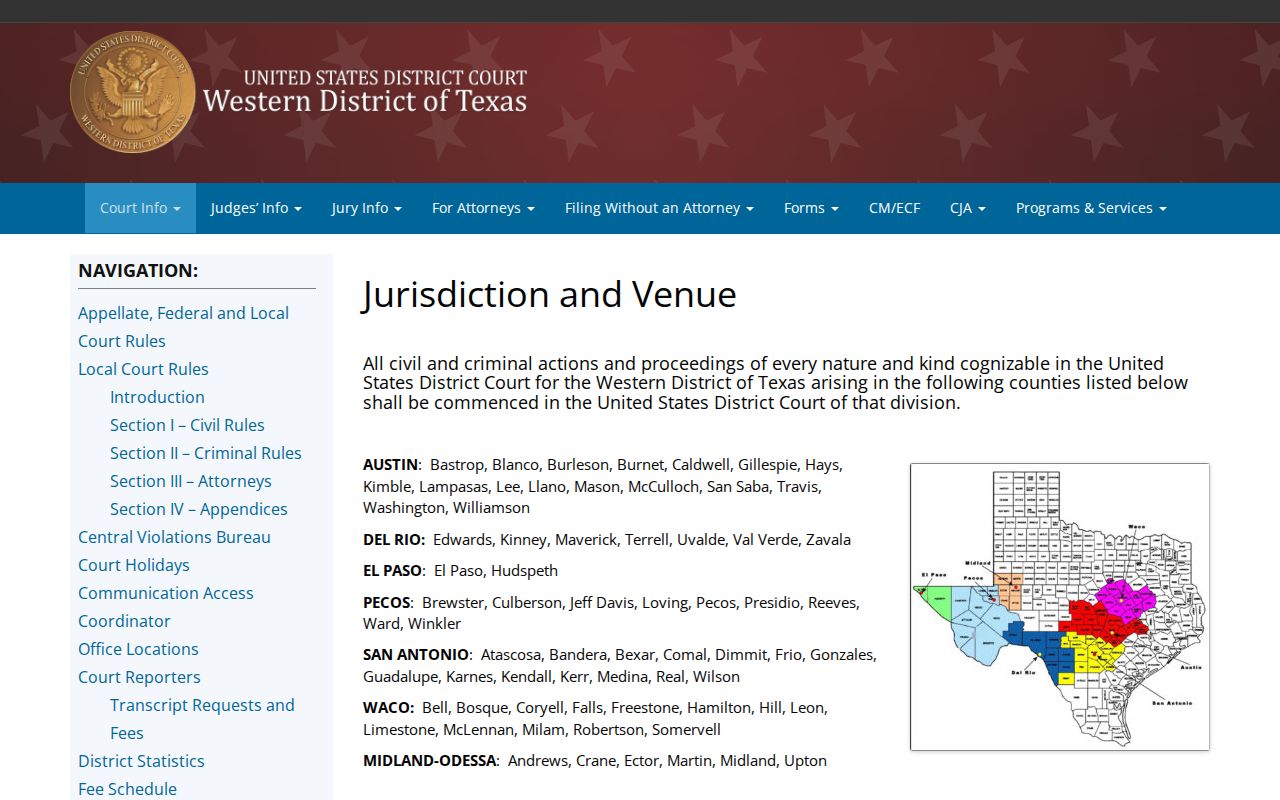
The image documents a federal venue route, not an arrest-warrant search page.
Handling an Arrest Warrant in Your Name
Believe an arrest warrant carries your name in Milam County? Call a lawyer and the issuing court before anything else. Neither the county nor its courts run a public surrender window or a universal bond counter, so ask the court directly. Get the bond amount, the conditions, how to appear, and whether a judge must approve a recall or motion.
Do not rely on an online row or a missing search result. Confirm current status with the issuing court, and get legal help before planning a surrender or payment.
Keep your Milam County receipt or court order, and ask whether DPS also needs an update.